

Have you ever sat in a school information meeting, heard the words “HL”, “TOK” and “CAS” and did not understand a single word? Do not worry, you are not alone in feeling slightly lost. The IB Diploma has its own vocabulary, and it takes a while to decode.
The good news is that the programme itself is far more logical than it seems at first!
This guide walks you through:
- What the IB Diploma is
- How the IB Diploma Programme is structured
- How IB students are graded
- Whether the IB is the right fit for your child
- Where students tend to struggle and how they can get support
What is the IB Diploma?
The International Baccalaureate Diploma Programme (usually shortened to IB Diploma or IBDP) is a two-year pre-university course for students aged 16 to 19. It was established in Geneva in 1968. Providing a balanced education, supporting families moving between countries and promoting international understanding were the original intentions behind the programme. Nowadays, it is taught in schools around the world and recognised by universities in many different countries. [1]
It differs from national systems such as the Polish matura or British A-levels in its breadth. A-level students typically specialise in around three subjects. IB students, however, study six, alongside three additional core components. In other national systems, students may focus on a smaller number of final examinations or follow a particular national curriculum, whereas the IB combines a broad subject choice with ongoing coursework and independent research.
In simple terms: the IB Diploma is a broad, demanding, internationally recognised qualification that asks students to think across multiple subjects.
The broad structure
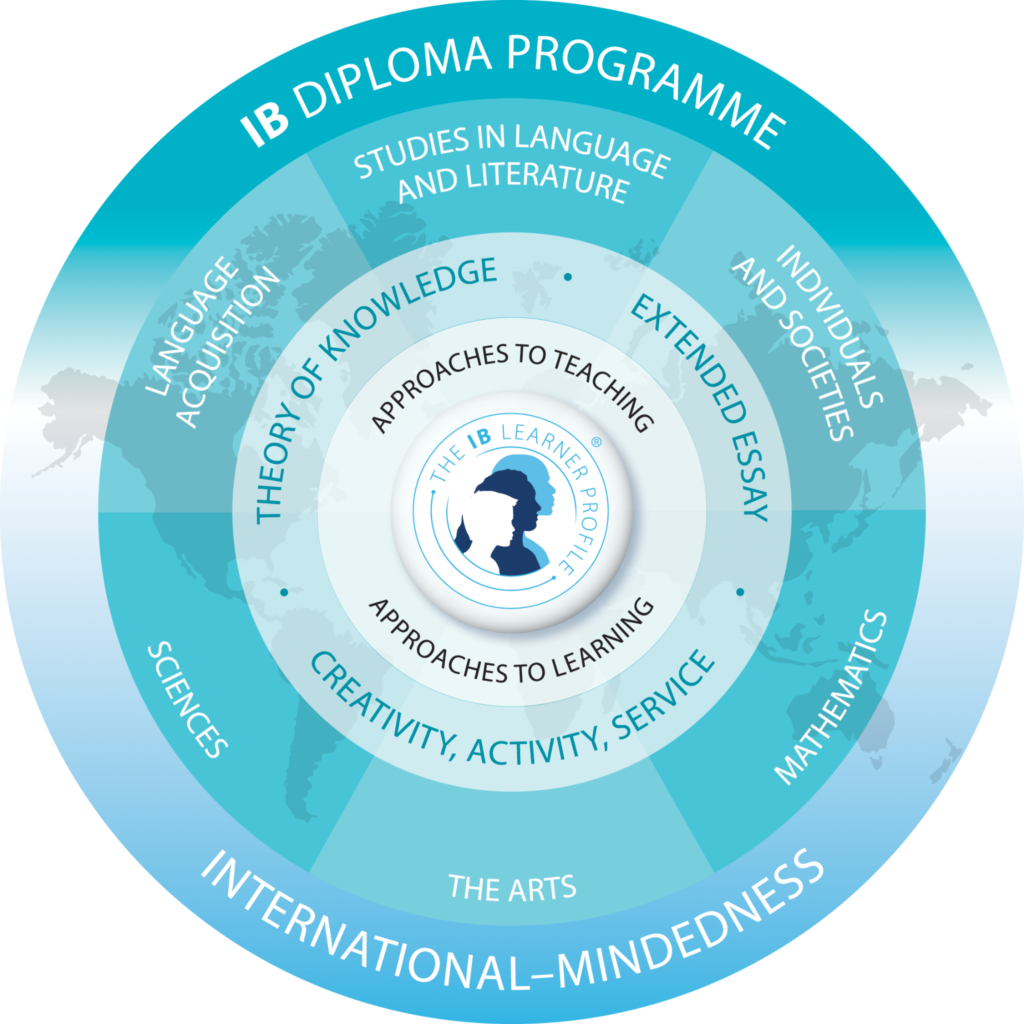
This is a rundown of every element in the programme.
| Component | What it involves |
| Six subjects | Usually one from each of five subject groups, plus a sixth from the arts or another subject group |
| Higher Level (HL) and Standard Level (SL) | Usually three subjects at HL and three at SL |
| Extended Essay (EE) | An independent research paper of up to 4,000 words |
| Theory of Knowledge (TOK) | A course on how we know what we know, assessed through an essay and an exhibition |
| CAS | Stands for Creativity, Activity and Service. CAS is a long-term programme that students must complete without sitting any examinations |
© International Baccalaureate Organization 2024
The six IB subject groups
IB students choose six subjects from the following groups, typically taking one subject from each group. [2]
Group 1: Studies in language and literature. Commonly your first language, such as English or Polish. Expect reading, essays and plenty of text analysis.
Group 2: Language acquisition. Second languages, such as English B, French, Spanish or German.
Group 3: Individuals and societies. Think economics, history, geography, psychology, business management and similar subjects.
Group 4: Sciences. Biology, chemistry, physics, computer science and others.
Group 5: Mathematics. Here, students choose between Analysis and Approaches (more algebra, calculus and proof, suited to future mathematicians, engineers and physicists) and Applications and Interpretation (more statistics, modelling and technology).
Group 6: The arts. Students who would rather not take an arts subject, such as Visual Arts, Music, Theatre or Film, can choose an additional subject from Groups 1 to 4 instead.
If you’re wondering how to choose between these options, we will shortly release a separate guide on “choosing your IB subjects and the HL vs SL decision”. It’s one of the biggest choices in the whole programme, so stay tuned!
Higher Level vs Standard Level (HL vs SL)
Out of the six subjects, students take three at Higher Level (HL), and the remaining subjects at Standard Level (SL). In some cases schools may allow students to take a fourth HL subject, but it is not advised. It may be appropriate for someone who is genuinely strong across their subjects, or if an additional subject is required for a future university application.
HL isn’t simply SL but harder – it means more teaching hours (approximately 240 compared to 150 for SL over the two years), more content and greater depth. There is a significant jump in workload between the two, and oftentimes students underestimate it when picking subjects. [2]
Our tip: choose HL for the subjects connected to what you want to study at university, and for subjects where you’re genuinely curious rather than just competent. Check university entry requirements before making your final choices.
The IB Diploma core parts that make the programme what it is
Imagine the six subjects are the bricks, whereas the core is the mortar. This part is where a lot of students feel the pressure, because the core is not normal schoolwork.
The Extended Essay (EE)
The Extended Essay is an independent research project of up to 4,000 words on a topic and in a subject of the student’s choice, although it is strongly suggested to choose from one of three HL subjects. It is supervised by a teacher. Nevertheless, it is the student that must perform all the hard and time-consuming tasks such as choosing a research question, finding sources, building an argument and writing it up. [3]
On the bright side, it is excellent preparation for higher education, and it gives students an opportunity to explore a subject in greater depth. It is also the thing that sneaks up most on students, as a research question that sounds fascinating in October can turn out to be unanswerable by February. Therefore, starting early and keeping the question narrow is the best advice we can give.

Theory of Knowledge (TOK)
TOK is the part of the Diploma that is the hardest to explain, but oddly a part that students oftentimes enjoy the most. It’s a course about knowledge itself. How do we know what we claim to know? What’s the difference between knowing something in mathematics and knowing something in history? Why do experts disagree?
It’s assessed in two ways:
- An externally assessed essay of up to 1,600 words, written in response to a title prescribed by the IB. The essay titles change between examination sessions.
- An internally assessed exhibition in which students connect three objects to a selected TOK prompt. [4]
CAS: Creativity, Activity, Service
CAS is present for the two full years and isn’t graded, but students must complete its requirements to earn the Diploma. The three strands are Creativity – creative pursuits, Activity – physical activity, and Service – activities that benefit others. Students also complete a CAS project and reflect on their experiences along the way. [5]
How is the IB Diploma graded?
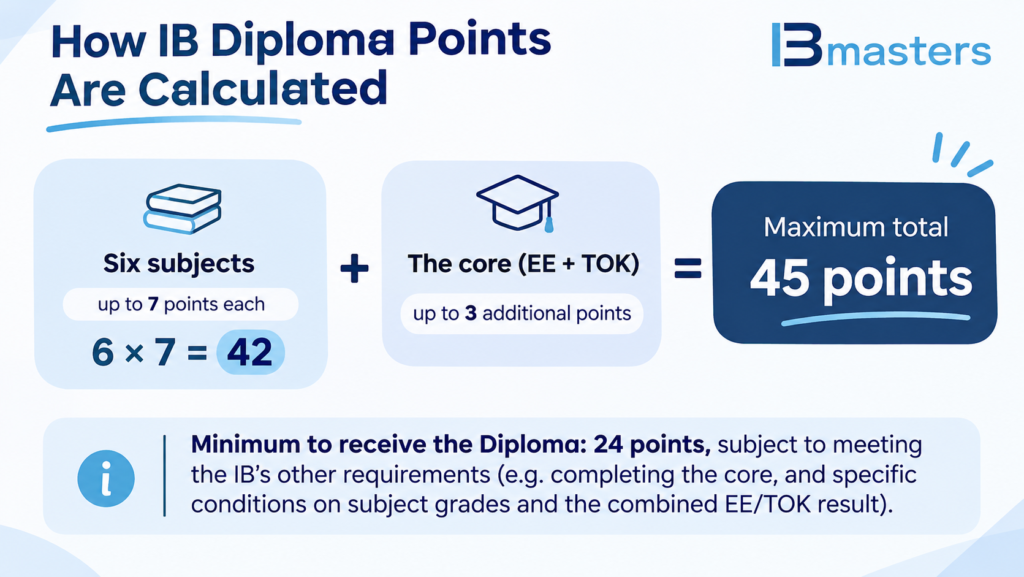
Each of the six subjects is graded from 1 to 7, with 7 being the highest. That gives a maximum of 42 points from the subjects. In addition, the Extended Essay and TOK are each awarded a grade from A to E, and together they can contribute up to 3 additional points. The total maximum is therefore 45 points. [6]
To receive the Diploma, a student needs at least 24 points and must also meet the IB’s other minimum requirements. These include completing the core components, obtaining at least 12 points from HL subjects and 9 points from SL subjects, meeting specific conditions relating to subject grades and the combined TOK and Extended Essay results. [7]
Final subject grades come from a mix of internal assessment (an essay or, in the case of languages, an oral exam, completed during the programme) and external assessment (examinations). Each subject has its own balance and assessment structure, so it is important not to assume that every subject has the same coursework weighting. If you’re taking maths, our soon-to-be-posted guide to the “IB Maths IA” is a good starting point. [8]
What’s a “good” IB score? It depends entirely on the university and course, as entry requirements can vary considerably, even between programmes at the same university. Competitive courses often ask for high overall points as well as specific grades in Higher Level subjects. It is important to always check the requirements for the programmes you’re considering rather than relying on a general score guide.
Where can the IB Diploma take you?
Recognition is one of the Diploma’s biggest strengths. IB students continue their university studies in Poland, the UK, the US, Canada, the Netherlands, Germany, Australia, across Asia and beyond. However, this does not mean that every university or course has identical entry requirements. Some institutions may also consider strong HL results when assessing applications for credit or advanced standing, but this depends on the university and programme.
If your child is aiming for the UK, it is worth understanding how universities use UCAS Tariff points. The IB has tariff values, but not every university uses the Tariff, and institutions do set their own entry requirements. They may ask for an overall IB score, particular HL subjects or specific grades. It is a topic that causes a lot of confusion, but do not worry – we will shortly release a guide to “IB to UCAS points”. [9]
What makes the IB Diploma hard?
We’d be doing you a disservice if we only listed the advantages. Here is what we see most often from students who find the IB tough.
Time management is extremely important: six subjects, internal assessments, the EE, TOK, CAS and, usually, a life outside school may be challenging. Try to stay on top of your work, as falling behind in even one area tends to snowball into others.
Deadlines overlap: Due dates all land in the same few months. Students who plan backwards from deadlines cope far better than those who work week to week.
The writing demands are high in every subject: Even in science and maths, students are expected to communicate their reasoning clearly.
The pace is constant: There is no “easy” term. The first year is a time for students to build the foundations for the rest of the programme. Even then students undergo intense academic learning.
This does not mean that the IB is impossible. Thousands of students obtain their Diploma each year. A student who goes in with realistic expectations, and who gets support early rather than late, tends to do much better than one who waits until things feel out of control.
Is the IB Diploma right for you?
There’s no single answer, but asking yourself a few questions can help.
You may thrive in the IB if you:
- enjoy a broad range of subjects
- are curious and do not just want to memorise
- are reasonably organised, or willing to learn how to be
- are considering university abroad
- enjoy writing, discussing and analysing
It may be a harder fit if you:
- are very strongly drawn to one narrow field and would rather focus entirely on it
- find it difficult to manage multiple deadlines at once
- are looking for a programme that relies mostly on exams at the end, with little ongoing work
Of course, this is only a suggestion and plenty of students who do not tick every box in the first list do very well. Motivation and good habits often lead to better results than natural ability, and the programme itself is a fantastic opportunity to develop those habits along the way.

How IB tutoring and university counselling can help
There are points in the programme where personalised support can make a real difference: coming up with a strong Extended Essay question, understanding what examiners want in a particular subject, working through the Internal Assessment, or making sure your subject choices are in line with university entry requirements.
At IBmasters, tutors support IB students across all subjects and levels, including subject content, coursework, Extended Essays, Internal Assessments and exam preparation. Finding the right IB tutor can help students work through difficult topics, prepare for IB exams and build confidence in their subjects. The university application team also helps students with choosing courses and universities, personal statements, exams and interviews. If you’d like to talk through where your child is right now, the team is happy to have a conversation. [10]
Frequently asked questions about the IB Diploma
Is the IB Diploma harder than A-levels or the Polish matura?
It is not necessarily harder, but rather different. The IB is broader and demands consistent work across six subjects and the core over two years. It depends on the student whether that feels harder, as well as on their strengths and the education system they are used to.
Can you fail the IB Diploma?
In short, yes, you can. A student may complete the programme but not meet all the conditions for the full Diploma. In that case, they are entitled to receive results for the individual IB subjects they took. The minimum passing score is 24 points, assuming that other requirements have also been met. [7]
Can I study the IB Diploma in English if it isn’t my first language?
Yes, and many students do. Strong English is important, particularly for the writing-heavy parts of the programme, so building language skills early is worthwhile.
Where can I find an IB tutor?
Students looking for additional support can consider working with an IB tutor who understands the requirements of the Diploma Programme and the expectations of individual subjects. IB tutoring can help with subject content, coursework, Internal Assessments, the Extended Essay and exam preparation.